
Searching Gage County Criminal Dockets
Begin at the Nebraska JUSTICE One-Time Court Case Search. It covers Gage County County Court and District Court cases alike. Pick Gage, then search by party name or an exact case number. Why does court type matter? County Court holds misdemeanors, infractions, ordinance matters, and felony preliminary proceedings. District Court keeps the felony trial record after bind-over. The free result list flags possible matches. Opening a match leads to the case summary and Register of Actions through whichever access option you selected.
Spell a name the way the court does. The official demonstration shows the individual-name format: last name, first name, middle initial, and suffix when present. With a common name, add Gage County plus one useful filter rather than trusting a caption alone. Court type, year, case type, judge, or attorney can all narrow the list. County by itself must be paired with another criterion. Once a match appears, record the case number, court type, and filing year.
- Open the official JUSTICE search with JavaScript enabled and select a name or case-number route.
- Enter the party name in the court-record format, select Gage, and add a court type when known.
- Review the possible-match list for the caption, case type, party, judge, and attorney fields that are available.
- Open the matching case and read the Register of Actions from the oldest entry forward, then check the newest setting.
- Use the holding clerk for a certified copy, an older paper file, or an entry that needs local confirmation.
Gage Criminal Docket Search Fields
JUSTICE applies the same statewide search controls to criminal matters. Court type plus criminal case type help you separate a Gage County Court docket from a Gage District Court docket. The live form does not publish every Gage-specific subtype in its accessible text. Rely only on options the current form shows. An exact case number is the straight path in. For name searches, use filters to trim a long list without touching the party name's spelling.
| Field | Use in Gage | Required | Practical note |
|---|---|---|---|
| Party Name | Individual or entity | Core name field | Match the court record, including spaces and any recorded middle initial. |
| County | Select Gage | Optional | Pair it with a name, year, number, or another criterion. |
| Court Type | County or District | Optional | Search both when a felony may have been transferred. |
| Case Type / Subtype | Criminal-related choices | Optional | Use the current live choices rather than guessing a code. |
| Case Number | Exact identifier | Required for direct search | Copy punctuation, spaces, prefix, year, and sequence exactly. |
The Nebraska Judicial Branch felony preliminary-hearing procedure lays out the County Court stage that decides when a felony moves toward the District Court record.
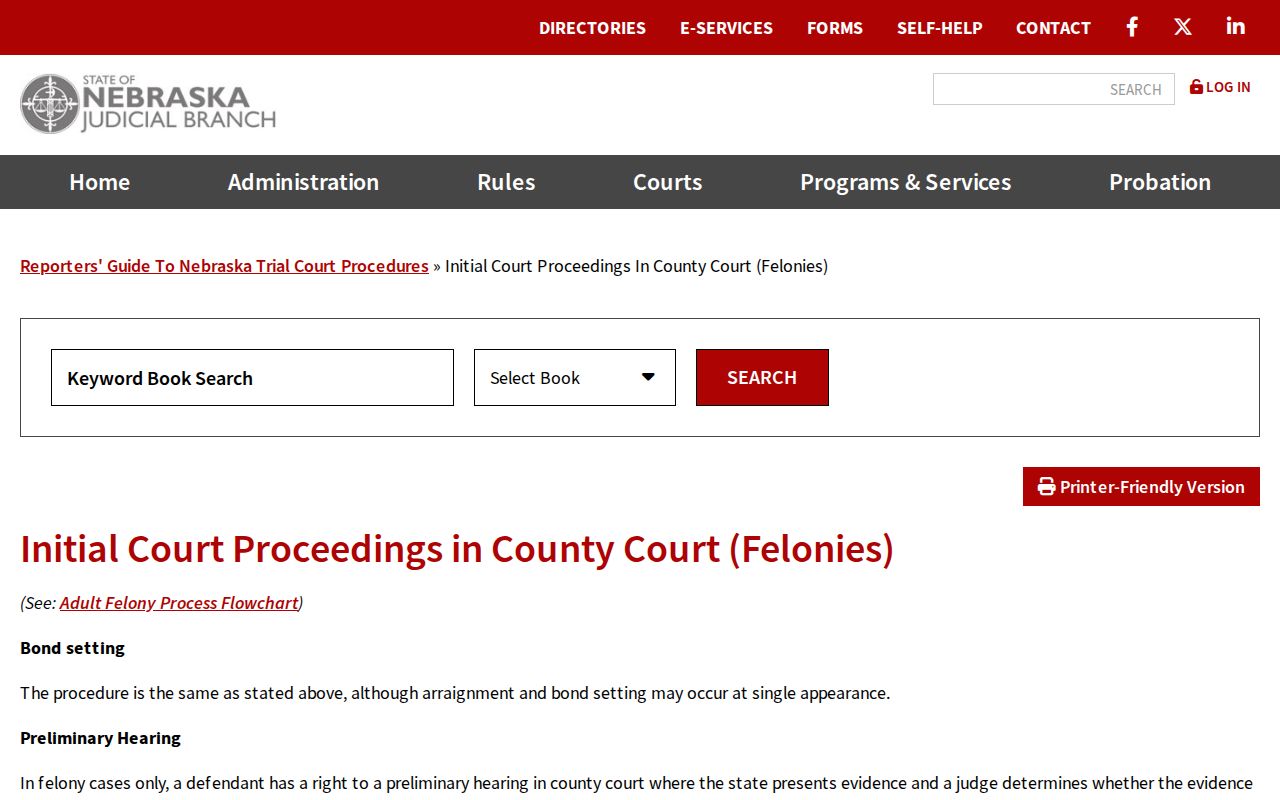
That is why court type comes first when you read any Gage County criminal docket result.
Inside a Gage County Criminal Docket
Open a criminal case and you may get a case summary. It can also include a chronological Register of Actions. The header can name the Gage court, the case number, the criminal case type, a filing or complaint date, the judge, and the status. Parties usually include the State of Nebraska, the defendant, and attorneys. The charge block may list a count, an offense description, a classification, and a statute where one was entered. Remember that a charge at filing is only an allegation. It is not a later finding.
| Case number | Use the displayed identifier exactly. State materials show forms such as CR 16-82, but no complete Gage-specific numbering grammar is published. |
|---|---|
| Charge block | May show count number, offense, classification, and changes such as an amended or dismissed count. |
| Settings | Shows a hearing date, time, location, and type, such as arraignment, preliminary hearing, plea, restitution hearing, or sentencing. |
| Register of Actions | Chronological filings, appearances, hearings, orders, transfers, and other recorded events. |
| Financial activity | May list fine, costs, restitution, bond, or payments. A balance is not the case disposition. |
| Disposition | May record a plea, conviction, acquittal, dismissal, sentence, appeal, or remand. Read each count and order. |
The Nebraska Judicial Branch Gage District Court contact card names the court and the clerk route for the trial-level felony record.
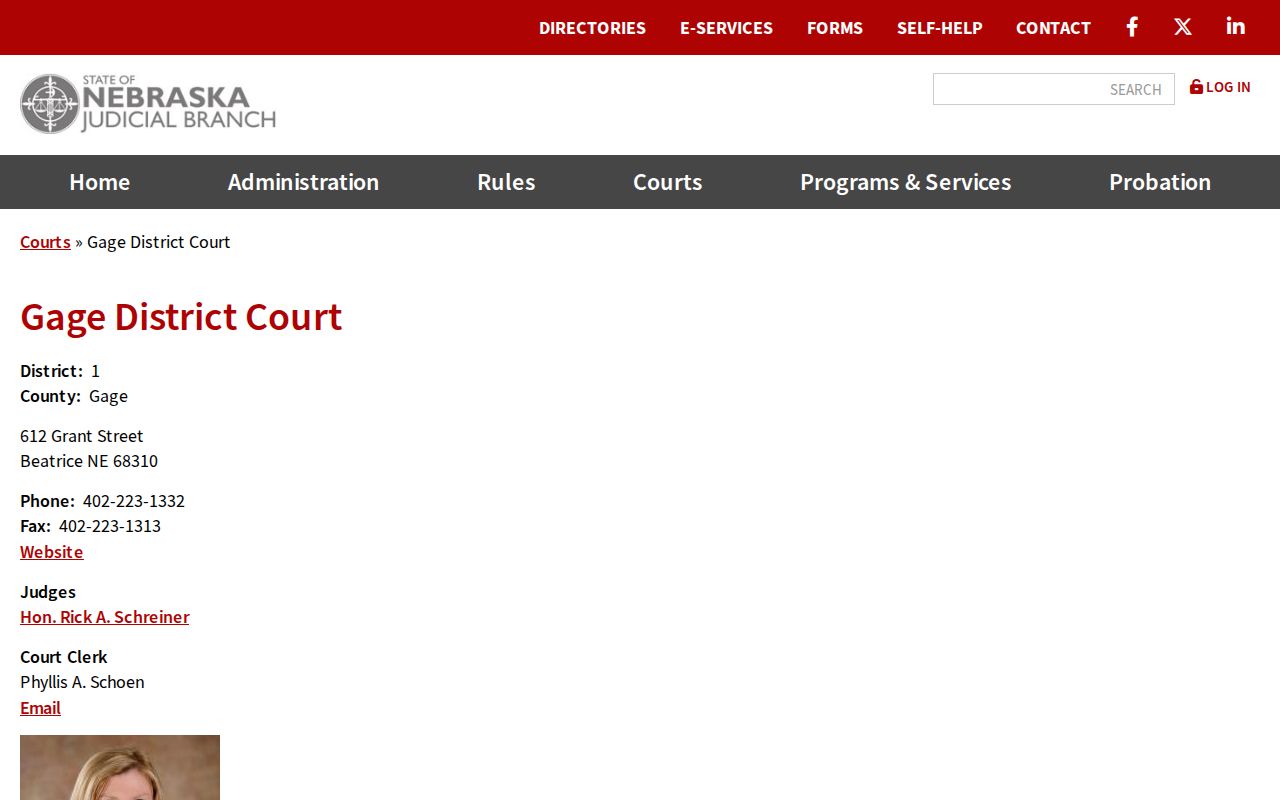
For a District Court felony record, the District Clerk can explain a public docket entry or issue a certified copy.
Gage Felony Dockets Cross Two Courts
One Gage felony can create two linked criminal dockets in two different courts. County Court handles the complaint, bond, and preliminary-hearing stage. There the court weighs probable cause, or the hearing is waived. On bind-over, the trial-level case continues in District Court. Nebraska Court Rule § 6-1453 directs electronic transmission of the original file through JUSTICE, and the County Court Register should show that transfer event.
This split explains a common dead end. A County Court register that stops after a preliminary event may simply mean the matter moved, not that it ended. Search the other court type using the party name and any new case number, then compare dates and event order. The state's felony preliminary-hearing explanation covers the county-court stage before District Court proceedings begin.
Nebraska Court Rule § 6-1453 governs the electronic transfer that shows up in a Gage County criminal Register of Actions.
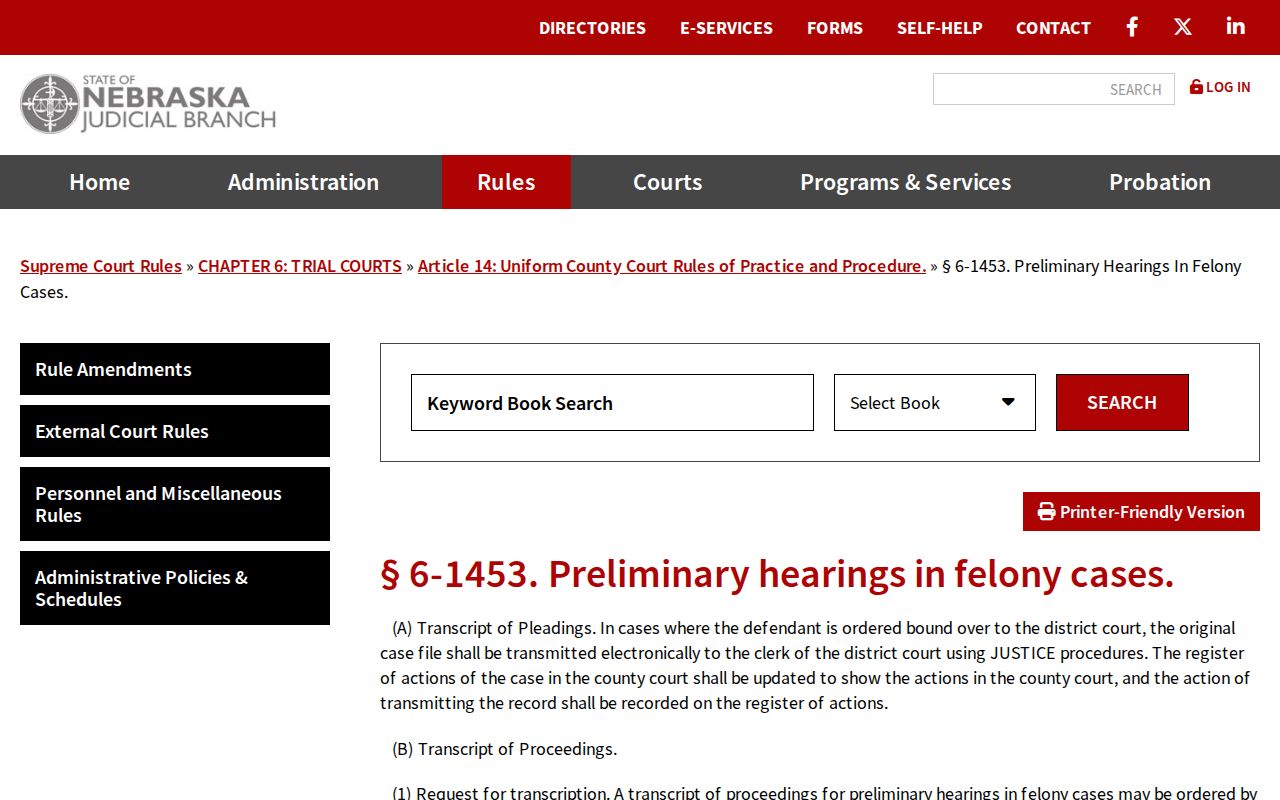
The rule marks the transfer point where a County Court preliminary record and a District Court criminal docket must be read as one story.
How a Criminal Case Moves
Read criminal entries as a sequence, never as isolated labels. A complaint or citation often leads to an appearance and bond entry. A felony may then show a preliminary hearing or waiver, a bind-over record, District Court arraignment, pretrial events, plea or trial, and sentencing. Misdemeanors generally stay in County Court. Later, an appeal, remand, restitution entry, or payment can add events. None of that changes the original judgment's meaning.
Criminal docket flow: Complaint or Citation → Initial Appearance and Bond → Preliminary Hearing or Waiver → District Court Arraignment for a Bound-Over Felony → Pretrial → Plea or Trial → Disposition and Sentencing.
A preliminary hearing only tests probable cause. It is not a trial and not a finding of guilt.
Gage Criminal Docket Terms
JUSTICE often uses a short event label. The underlying order or a later Register entry supplies the fuller context. Copy the exact live text, and ask the clerk about any unfamiliar code. No certified Gage-only codebook is published. These common terms help you tell a movement in the case from an outcome.
- Bound over
- A felony preliminary matter transferred from County Court to District Court after the probable-cause stage.
- Arraignment
- A formal appearance where charges are addressed and a plea is entered or requested.
- Continuance or reset
- A hearing moved to another date. It is not a final case outcome.
- Disposition
- The recorded outcome, such as dismissal, conviction, acquittal, or an entered sentence.
- Bond forfeiture
- A court action declaring bond security forfeited after a triggering event, often an appearance failure.
Read a Gage County criminal docket count by count. One count can end in a plea or conviction while another is dismissed. Appeals and remands are procedural steps, not new dispositions. When the docket summary runs short, rely on the signed judgment or order for the legal terms.
Courts That Hold Criminal Dockets
Gage County Court handles the local criminal docket. That means misdemeanors, traffic infractions, city ordinance violations, extraditions, and felony preliminary hearings. Its Clerk Magistrate sits in Room 17 of the Gage County Courthouse. The state County Court page assigns those limited-jurisdiction criminal matters here. Traffic and misdemeanor cases stay County Court dockets. They do not become District Court records just because they are criminal.
Gage District Court takes the felony trial record after bind-over. It also handles later serious criminal proceedings, sentencing, and applicable appeals. The Clerk of the District Court works from Room 11. The courthouse sits at 612 Grant Street, Beatrice, Nebraska 68310. Know which room holds the file. Check that before requesting a case record or confirming a court date.
The Nebraska Judicial Branch Gage County Court card lists the official County Court contact details.
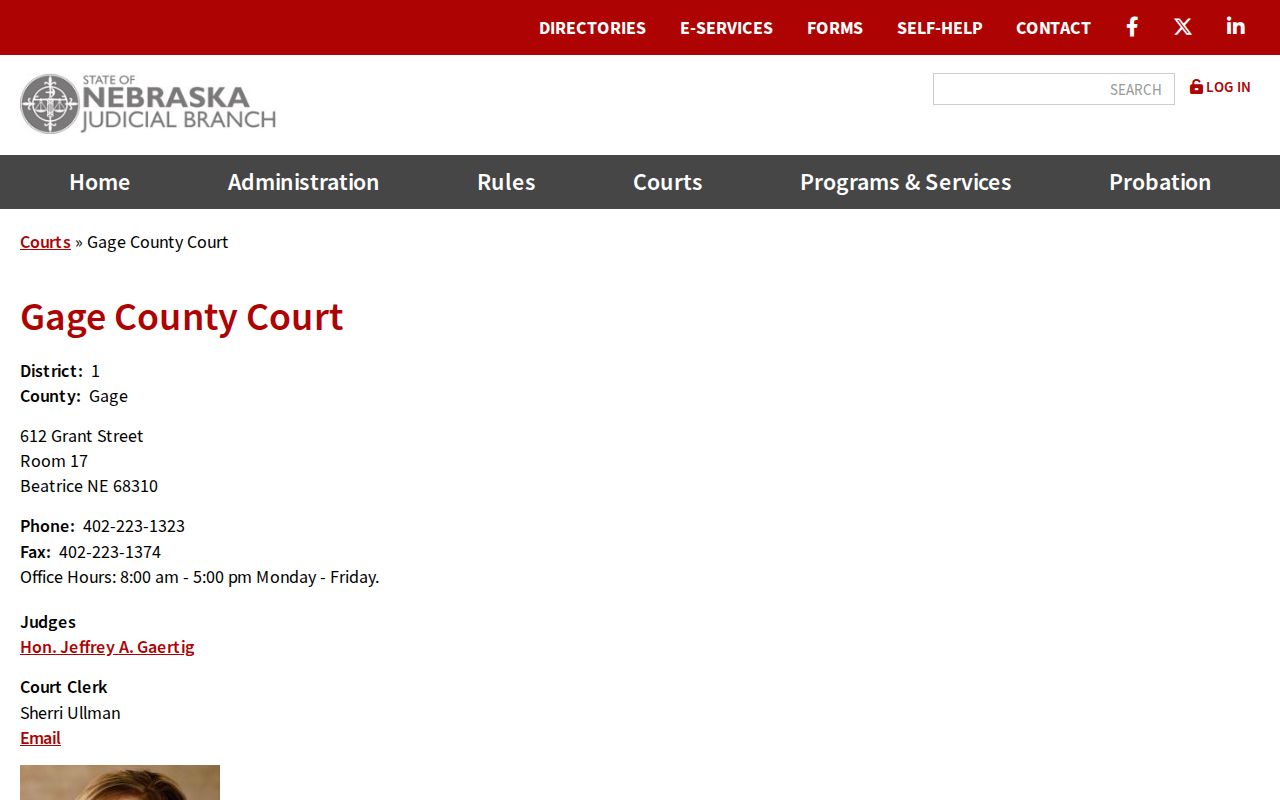
Clerk contact: the court contact card is the quickest reference when a Gage criminal docket needs a county-level clerk confirmation.
Gage Criminal Docket Clerk Access
A web search is not the only way in. County Court dockets can be checked in person. Stop at the Room 17 counter or call 402-223-1323 for that court. Felony files sit with the District Clerk. That office is Room 11, at 402-223-1332. It also holds related filings alongside District Court cases. The courthouse keeps a public JUSTICE terminal. Visitors can search there by party name or case number during courthouse hours, and it gives them a way to inspect an electronic court record on site whenever a web search is unavailable.
Older files are not always digital. They may live on paper, microfilm, or in an archive, so ask the clerk who holds the record what it can retrieve. A written request works best. It should name the case number, the document wanted, the date, and whether a certified copy is needed. Gage sends unclear public-record requests to the department that keeps the record. When no one can tell which office that is, the County Clerk can forward the request. Court transcripts are a separate matter. They come through court-reporting personnel rather than as ordinary docket copies. To search public cases across record types, use the Gage County case lookup page.
Nebraska County Court information explains the court's jurisdiction. That jurisdiction covers criminal matters and preliminary hearings, and it routes a Gage matter to the County Court clerk.
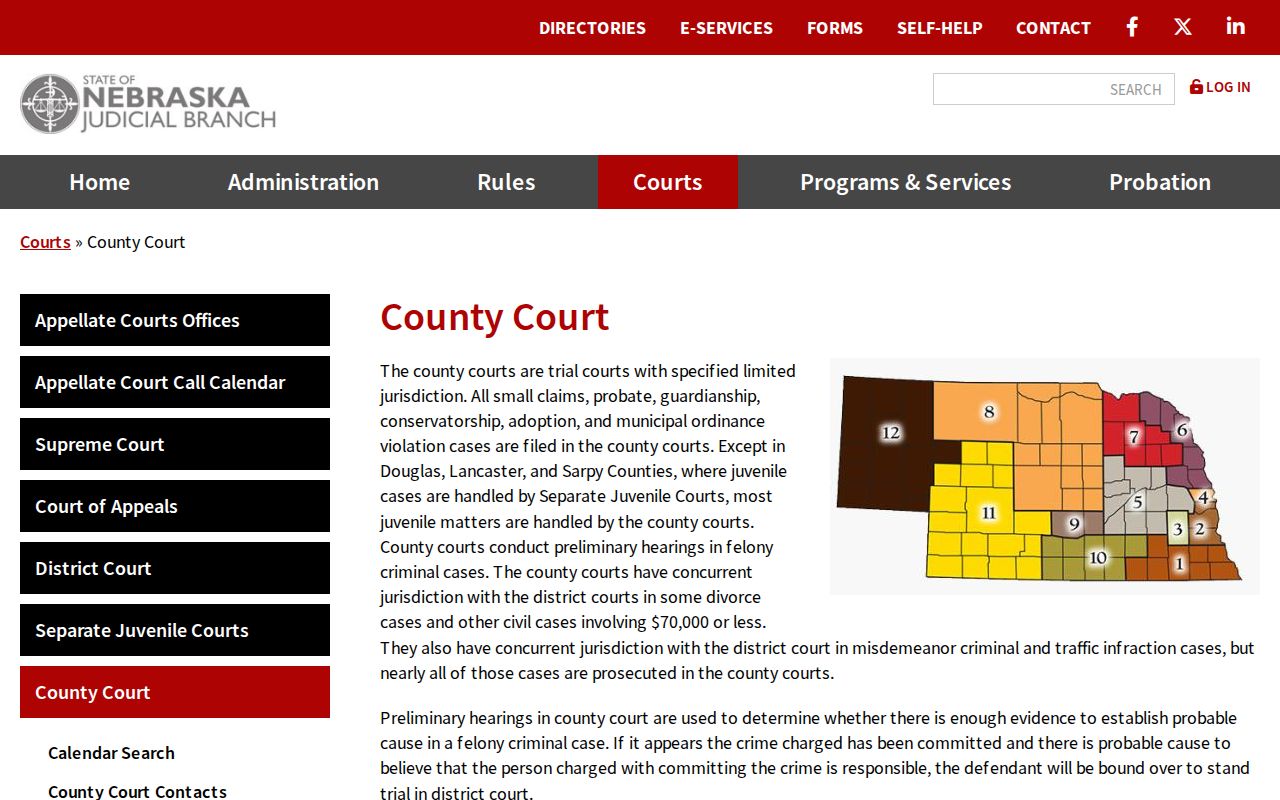
That jurisdiction reference is a useful dividing line. It separates a County Court criminal docket from the District Court record of a transferred felony.
Gage Criminal Docket Result Limits
JUSTICE caps its one-time service at 30 cases. If a Gage County criminal name search returns more, narrow it with a court type, case year, criminal type, judge, or attorney instead of assuming the list is complete. The statewide system updates nightly. A newly filed case can lag by 24 hours. Coverage also varies by case, since not every field is entered or visible in every record.
When the exact result is missing, check the other court level, the spelling, installation-year coverage, paper archives, and access restrictions before drawing a conclusion. The courthouse public terminal is one fallback. The owning clerk is another. A clerk can confirm whether a public entry exists and whether a paper or certified copy can be produced.
Sealed Dockets and Public Access
Public electronic access covers party indexes, case summaries, Registers of Actions, calendars, and available images unless a law, rule, or order restricts them. The system hides Social Security numbers, witness information, sealed material, and juvenile confidential information. A blank result has many possible causes. Spelling, the nightly update cycle, installation-year coverage, a paper archive, the wrong court type, or a restriction can all be responsible. The empty screen proves nothing. It does not establish any case outcome by itself.
Key Rules:
Neb. Ct. R. § 1-805 makes public electronic court information available, including Registers and calendars, subject to restrictions.
Neb. Ct. R. § 2-215 provides for public viewing of filings unless law, rule, or order restricts them and preserves terminal inspection.
Neb. Rev. Stat. § 29-3523 governs when adult criminal record information becomes nonpublic after the applicable order and period.
The adult criminal-record restriction statute explains why a Gage County criminal docket can drop out of public search after a qualifying order.
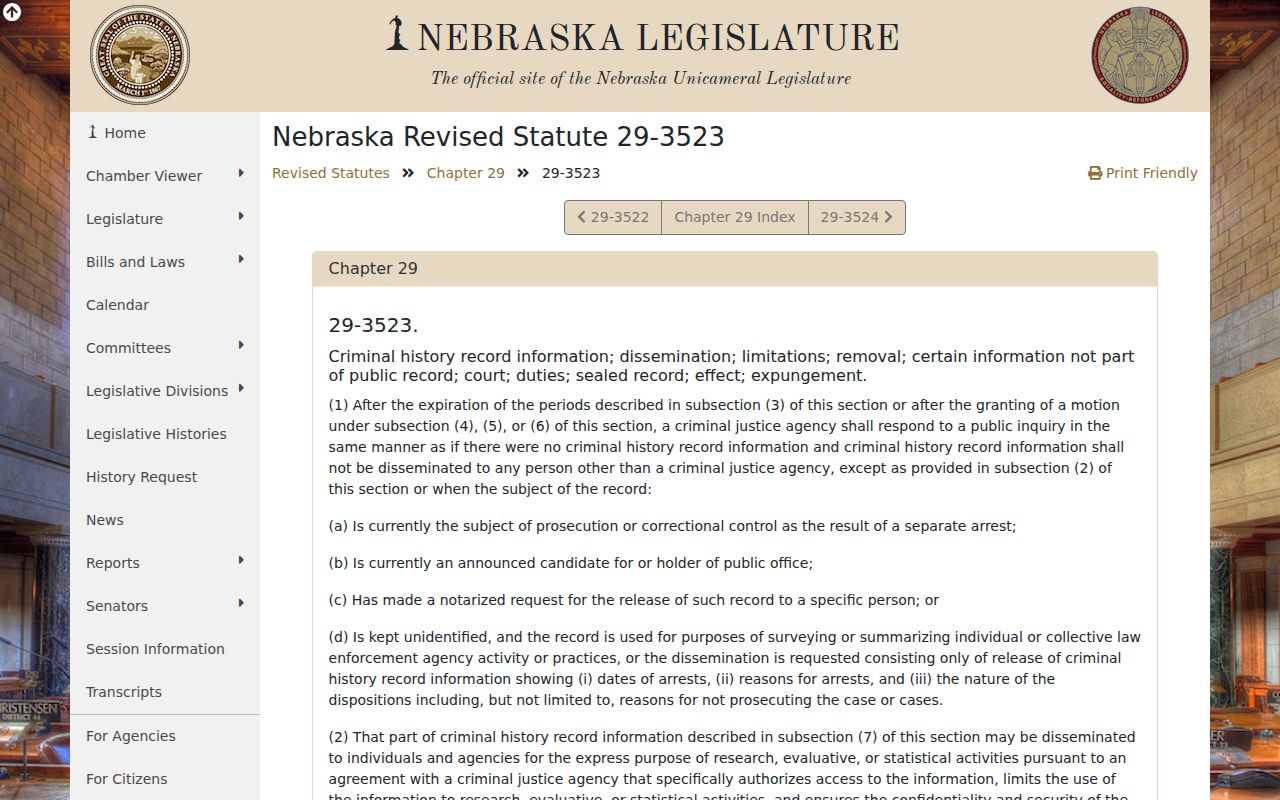
A rule, statute, or court order governs any restriction. For a public-access question, contact the clerk who owns the record.